To most, paper folding—origami—is just a childhood game, where clever little objects come to being from a flat piece of paper. However, to those who understand its depth and potential, it is an art form, a science, that literally leaps out of the page and becomes bigger than life.
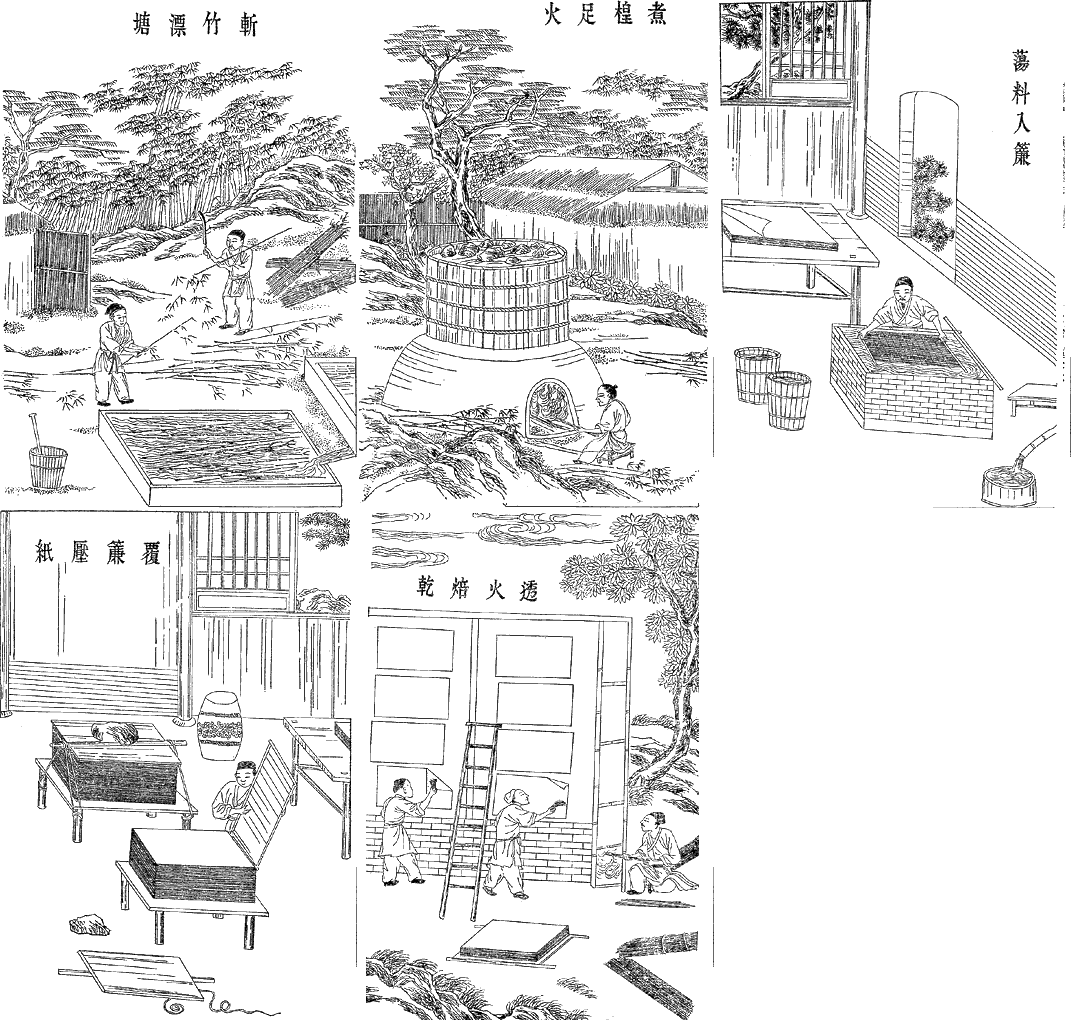
Paper was invented in China sometime in the First century AD, and spread to Japan by Buddhist monks. In China, archeological evidence show that even before paper was used for recording, it was used to make objects like containers and hates, it is also a Chinese tradition to burn paper folded cloth and Gold sycee for funerals. However, Chinese paper folding however reminded quite simplistic and practical. The potential of origami was finally explored when it spread to Japan. Traditional uses for origami in Japan also began with ceremonial use, for wedding and funerals, but evidence of origami as art was found in ancient poetry—stories of folded animals coming to life, or dreams with paper butterflies. This use of paper to create complex forms is the beginning of origami as tectonic art. Masters of origami emerged, developing techniques and competing for more detail or genius in design.
Although it seems intuitive, the method of creating 3 dimensional forms from a 2 dimensional medium is based on mathematics, specifically geometry and algorithms. Each fold is like a chess move, a critical step to the final outcome: each fold is precisely calculated in the mind of the maker to reach the final form. There are never any unnecessary folds, but a multitude of creases may be needed to create a single detail. Every fold or crease has to be planned from the first fold to the last. Origami design inspires such a sense of tectonic purity: monolithic material, legibility in structure, and the perfection of joinery in its jointlessness. There is no superfluous detail.
These qualities of origami have many professionals, from bio-engineers to architects, fixated on what was called a kid’s game. The study of origami taught engineers methods for constructing deployable structures. The most well used example is the airbag, and the most grand is solar sails for space satellites. Technology continues to grow even beyond the paper as software is developed for simulating and computing folding algorithms. In architecture, origami inspired many compactable shelters for nomadic dwellers (the homeless) on a small scale, as well as the Yokohama International Cruise Terminal by FOA on the large scale.

An architectural movement that origami contribute greatly to is biomimicry. Even though the craft has existed before written language, origami as a case of biomimicry is something that was discovered recently with advancements in biology. One basic example is how a leaf folds out of its bud and expends. Another is protein folding. How proteins differ from one another and perform different functions is all based on the way it is folded. Even the most important part of us, our DNA, is folded to fit our cells. Nature is the inventor of folding, ancient China brought folding onto paper, and there is endless potential for folding in other applications.
 Below are images of my origami of a Hyperbolic Paraboloid. The structure is a mathematic quadric surface, a form famously used by Félix Candela for the Los Manantiales Restaurant. The structure is most perfectly explored in origami due to paper’s quality of wanting to retain its structure. Once folded, the page will remember its new molecular structure and try to return to that state. In this case, the straight folded creases cannot all fit on the Cartesian plane, so they naturally diverge to create the Paraboloid.