Wednesday, 21 September 2011


Many Eastern art forms are built upon the philosophies of Chinese calligraphy. It was developed over thousands of years of history and has gone through many innovative stages. Calligraphy was developed as a writing tool, but has evolved to be an art which emphasizes on line type, proportion of characters, and form of the characters. Because of its large influence on East Asian culture, calligraphy is held in high regard in many eastern countries, and is still practiced today. Traditional Chinese calligraphy is the art of writing Chinese characters using ink and an animal hair brush. Many aspects of a line can be manipulated with the brush. Subtle attention to details in a line such as the beginning and ends of strokes, the speed of the brush stroke, the angle and rotation of the brush while drawing are all important towards the overall style.

The kai shu style focuses on legibility and clarity and is a very calm and proper form of writing. It is currently the most widely used style of writing. Cao shu is akin to the cursive style in the West. It focuses on lightness, speed, and the spatial relationships between characters.

The process of writing calligraphy requires involves the entire body, and importance is given to posture, and stance. Because of this, the ideas of calligraphy carry on through to dance, martial arts, and meditation. The visual aspects of calligraphy can be seen in carvings, ink wash paintings, sculpture and architecture.

Marcus Poon

Thing To Wear


The Japanese kimono, which literally translates to "thing to wear" has been around for centuries as a traditional garment for the Japanese. This garment has evolved throughout the years that can portray different influences on Japanese culture like from the Chinese or the Western World. Starting from as early as the 5th century, ranging all the way to modern times, the kimono has changed specific details like the width of the belt or sleeves, but the general shape has remained the same. Often regarded as "pieces of art", the value of a kimono can drastically increase with the textile or fabrics used along with the design.

The kimono is a significant contribution in Japanese culture because it is a traditional piece that people wear and use on a daily basis. It is a piece of art that can be practically used in every day life. With uses that range from casual to extremely formal, the kimono continues to be a staple in Japanese culture
O-YOROI SAMURAI ARMOUR
NICHOLAS LEBLANC
3RD YEAR ARCHITECTURE STUDENT

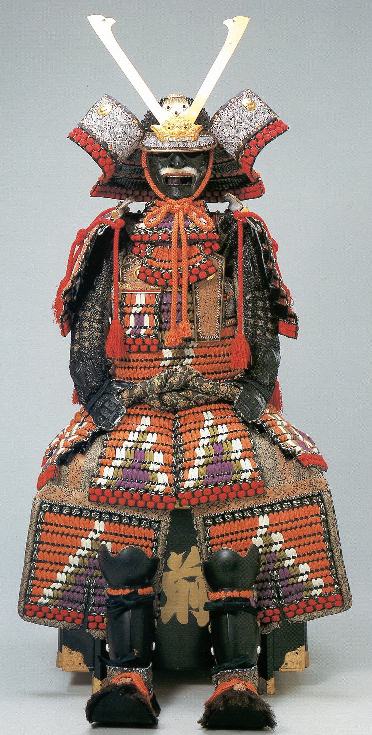
WARRIORS HAVE WORN ARMOUR AS EARLY AS THE FOURTH CENTURY. ARMOUR WAS CREATED TO PROTECT ITS BEARER FROM POTENTIAL DAMAGE FROM WEAPONS INFLICTED DURING COMBAT. O-YOROI IS THE NAME OF ONE OF THE LATER FORMS OF PROTECTION WARN BY JAPANESE SAMURAI WARRIORS BETWEEN THE TENTH AND FIFTEENTH CENTURY.

O-YOROI WERE WARN PRIMARILY BY HIGH RANKING SAMURAI WHO COULD AFORD SUCH PROTECT. THE BOXY SHAPE OF THE ARMOUR WAS NOT IDEAL FOR HAND TO HAND COMBAT BUT PROVIDED GOOD PROTECTION WHEN ON A HORSE (MAINLY FOR MOUNTED ARCHERS). A SET OF ARMOUR SIMILAR TO THE ONE IN THE IMAGE COULD TAKE UP TO AN ENTIRE YEAR TO CONSTRUCT MAKING THE O-YOROI AN EXPENSIVE AND PRIVILEGED OPPORTUNITY FOR A SAMURAI.

THERE ARE SIX COMPONENTS TO A O-YOROI ARMOUR. THE HELMET, FACIAL ARMOUR, CHEST ARMOUR, SLEEVE ARMOUR, SHIN AND THIGH ARMOUR. THE ARMOUR IS CONSTRUCTED OF MANY SCALES OF LEATHER AND IRON, LACED WITH CORD AND LACQUERED TO STRENGTHEN AND PROTECT AGAINST DECAY. COLLECTIVELY, THE ARMOUR CAN WAY UP TO 30 KG. EARLIER FORMS OF ARMOUR INCLUDED LARGE PIECES OF IRON WHICH COULD BECOME VERY HEAVY. O-YOROI ARMOUR COMBINES SCALES OF LEATHER AND IRON TO ALLOW FOR MORE FLEXIBILITY AND PROTECTION.

CONSTRUCTION OF THE O-YOROI WAS AN ART. CRAFTSMANSHIP WAS VERY IMPORTANT DUE TO THE COMPLEXITY OF THE COMPONENTS AND THE DETAILING OF THE LACE. THE COLOUR, DESIGN AND MATERIAL OF THE LACE IDENTIFIED THE CLAN OF A WARRIOR. CLANS ALSO HAD UNIQUE DESIGNS THAT WOULD BE PAINTED ON TH ARMOUR. RANKINGS WERE IDENTIFIED BY LACE. HIGH RANKING SAMURAI ARMOUR WAS LACED TOGETHER TIGHTLY WHILE LOWER RANKS HAD LOOSE ARMOUR.

THE COMBINATION OF AESTHETIC AND TACTILE USE OF O-YOROI SAMURAI ARMOUR IS VERY ELEGANT. IT IS NOT ONLY TO PROTECT THE WARRIOR WHO INHABITS THE ARMOUR BUT ALSO TO ASSURT HIS POSITION WITHIN THE RANKING. HONNOR OF THE CLAN DOES NOT SACRIFICE THE SAFETY OF THE WARRIOR BUT STRENGTHENS THE LINK BETWEEN TWO.


Si mu wu ding vessel (司母戊鼎)

China has a long history of using green bronze, and it is one of the most symbolic metals in the ancient China. Start from 5000 year ago China has entered the age called green Bronze Age. This age last for more than 2000 year until iron were appearing in the civilization and substitute green bronze. Ding vessel was the symbol of Chinese green Bronze Age. Before civilization appears, ding vessels were created by clays and it was used for burning food for worship ceremony. When the first dynasty Xia appeared, ding vessel was made in green bronze instead of clay and has a significant meaning in the civilization. The number of vessel a person could have symbolized his power in the society. According to “Zhou Li (周礼)”, the emperor could have nine ding vessels which symbolize the nine state in China called “Jiu Zhou”, dukes and barons could have seven, high officials five, and scholars three. People must follow this rule; any mistake made about the number of the vessel could result a serious criminal case for the person. . Therefore, we can find the person’s status by analysing the number of ding vessel inside of their tomb.


Si mu wu ding vessel is one of the greatest green bronze ware created in the Chinese history. It was excavate in1939 by a farmer in He Nan province. The vessel was made in Shang dynasty and was used by the emperor to worship his mother. The ding vessel is weight 832.24kg. The huge rectangle body is sitting on top of four legs that is empty inside. There is a vertical ear on each side of the vessel. The ear is also known as loop handle. The whole ding vessel was made in in piece from leg to the body, and the two ears were made separately and attached to the body later. The handle face was shaped into two tigers open their mouth toward each other and a human head between mouths. This figure of two tiger eating human’s head is a symbol of the great power owned by the emperor. The side of the handle has fish figure drawn on top. The rectangular body has ferocious animals figures Engraved on the each side. The whole picture on the side wall showes the great power of the emperor. Inside of the vessel, there are three words “司母戊” (Si mu wu) written on the wall. The name Si mu wu ding vessel came from these words. The beauty of this vessel shows us the highest point of green bronze art.

Zhaoyu Hunter Chen

The Pagoda Wind Chime (風鈴)

Chinese Antique Furniture


One of the many and most respected crafts of the antique Chinese dynasties was furniture making and great care was always taken to build furniture since there was a relationship between the scholar and those who built the tables on which they would write and paint. These highly respected craftsmen often relied on many intricate pieces and joints to construct their furniture more so than glue because of high temperature changes due to the Asian climate.

Similarly to the intricate architectural joints we’ve studied in class, a great amount of planning and craftsmanship went into designing and building such works of art. Like every kung-fu movie, where the grasshopper must first do menial tasks before receiving training from their master, an apprentice carpenter would start at the bottom and have to work his way up, gaining skills as he learns how to build furniture. Knowledge of how wood shrinks and warps and how to cut the wood was also past-on for generations. It is almost a shame that such craft and knowledge is disappearing to make place for large steel manufactured skyscrapers; perhaps there is much to be learned from these master craftsmen who would spend a life-time learning how to build a table.


Tatami Mats

Tatami Mats
Tim Stanley

Traditionally made of rice straw to form the core, with a covering of woven soft straw. Tatami mats are made in uniform sizes.
Size and Layout
In Japan, the size of a room and or function of a space is typically measured by both the number,  and configuration of the tatami mats. Based on the English measurement system, The proportion of a mat is:
.91 m by 1.82 m is about 2′11.83″ by 5′11.65″, which can be rounded to 3 ft × 6 ft.
4½ mats ≈ 9 ft × 9 ft
6 mats ≈ 9 ft × 12 ft
8 mats ≈ 12 ft × 12 ft

To give a general understanding of what function would take place in certain mat configurations; shops were traditionally designed to be 5½ mats, brazilian jiu jitsu martial arts mats to be 48 mats, and tea rooms are frequently 4½ mats.
Throughout the Edo period, tatami layouts gave rise to two new developments in pattern--auspicious and inauspicious layout. In the auspicious layout, the tatami was generally T-shape in form. Inauspicious tatami layouts generally took form of a (+) shape. Today, the auspicious layout is most commonly used. In a typical house, tatami mats should not be placed in a inauspicious layout—this pattern has been known to bring bad luck within a dwelling. Also, tatami should not be put in a grid pattern, they must be staggered so that 3 points of the edges do not meet. This is also a conspiracy of bad luck and evil.

History & Function
Tatami were originally a luxury item for the nobil and wealthy. During the Heian period, when the shinden-zukuri architectural style of aristocratic households was consummated, the flooring of shinden-zukuri palatial rooms were dominantly wooden, and tatami mats were only used as seating for the highest rank of people. Rules concerning seating and etiquette determined the arrangement of the tatami in the room.

Tatami become popular through time and finally reached the homes of typical families in  the 17th century Japan. Houses built in Japan generally do not have many tatami-floored rooms, if any. It is common to have only one room that has tatami mat-covered flooring. The rooms that have tatami flooring and other such traditional architectural features are referred to as nihonma or washitsu, "Japanese-style rooms". Tatami covered floors can functionally be used as a sleeping surface, a dining surface, a martial arts surface and a religious surface.
-End