Wednesday, 21 September 2011

Japanese Baskets

After researching for a significant amount of time, as to which Asian art piece or artifact interested me, I came across Japanese bamboo baskets.

Bamboo, having an intersting aesthetic quality, as well as being very sturdy, is a preferred plant to make wicker furniture. It also forms a very tough hardwood, which is used to make toys, intruments, fences, and ofcourse, Japanese baskets.

Japanese baskets date back to Muromachi period (1392-1568). They were first utilized as practical items where they were used for alter offerings. However, with time, they began to be used in tea ceremonies to display flowers, and eventually transformed into glorious works of art. Early artisans wove baskets from bamboo because of its toughness and durability and used them for Japanese tea ceremonies and for Ikebana flower displays. In present days, Japanese baskets also serve as fruit and letter holders.

When I first looked at the basket, I was in awe at how beautifully the basket was crafted and the durability of it. It has a harmonious and rhythmic feel because of the different sizes of bamboo that was used for its construction. This piece of art will continue to enchant people of today and the future, with its presence of harmony, simplicity, and elegance.

Himitsu-Bako

Himitsu-Bako (Personal Secret Box) is more commonly known as a Japanese Puzzle Box that dates back to over 100 years ago. Originating back in 1870, these boxes were created by a master woodworker named Ryugoro Okawa in the Hakone region in Japan.

These handcrafted puzzle boxes are not only intricate in their construction, but they are also decorated with a unique Japanese veneer called yosegi, dating back to the late Edo Period. Using a complex process of binding and cutting different species of wood, mosaic patterns are created to reflect Japanese culture.

In my opinion, the most interesting aspect with Himitsu-Bako is in its deception. As an object, it appears to be an ornamental box made from wood with no recognizable openings, latches, or hinges. However, with the correct sequence of precise movements or specific pressure points, this enables the lid to be slid open to reveal its contents.

The puzzle boxes were originally used to hold valuables and act as a hiding place for jewelry, coins and important documents. But since the art of making Himitsu-Bako has never been written down, it only allowed the creator or its owner to unveil its secrets.

The puzzle boxes can range from 1 sun* to 7 sun in size, referring to a traditional Japanese unit of measure to denote length. Some boxes are able to be opened within 2 moves, however more intricate designs can have up to 125 moves.

This art form is still in practice today in the Hakone region in Japan and is handed down in strictest confidence from generation to generation from master to apprentice. As a result, there are only a small number of people that have mastered the art of its craft and know the true secret behind Himitsu-Bako.

*1 sun = 1.22 inches

by: Bridget, M2

A Galaxy of Perception


My name is Amanda-Marie Thomas and I am a 4th Year Architectural Studies student. I have just returned from a sixteen-month Co-operative Education Work term in which case I am eager to apply my newly acquired experience and knowledge to my continued studies in the field of Architecture.

The sculpture that I have selected for analysis is "Galaxy" by Honda Syoryo.


Galaxy as Sculpture


This sculpture is comprised of bamboo and rattan that have been woven together using an openwork twining technique. Through the use of materiality and the basket weaving technique, a strong dialogue exists between structural rigidity required to sustain a fluid and seemingly evolving art piece. Furthermore, the dialogue between structure and fluidity occurs through the use of a predictable orthogonal weaving pattern and how it has been manipulated to create a non-uniform and inconsistent sculpture. This piece truly identifies with its sculpture quality as in entices the viewer to explore the varied conditions within its mass; including the depths and inhabitable spaces. The translucency of "Galaxy" also provides the sculpture with a sense of delicacy meanwhile its bulbous outreach demands presence.


Galaxy as Galaxy


As noted above, the dialogue between solid structure and translucent, fluid chaos speaks to the concept of "Galaxy". Galaxies are opportunities to understand space through a variety of layers. The masses within that space help one to understand voids as an all-encompassing concept. The use of openwork twining allows space to be framed through each an every square, emphasizing the relationship to galaxies that: it is the vantage point from which you view that is most informative to the overall composition. Both the concept and the form call for an interactive approach where you discover through maneuvering and rotating to gain a greater understanding of what the eye is perceiving.


Galaxy as Architect


Lastly, as an student in the field of Architecture, I was intrigued by how "Galaxy" speaks to the design profession as a whole. As Architects, the consistency of the profession calls one to marry a conceptual idea of spatial experience to a technically feasible means of construction. I find "Galaxy" inspiring in this consideration as it encourages one to explore beyond the current boundaries of materiality and discover alternative applications to service that conceptual experience.


Tuesday, 20 September 2011

Paper--China's greatest invention

Today, when we talk about China, it is usually about its power over global economy. However, what must never be forgotten is China’s immense influence on the history of civilization. Our world would not be what it is today without The Four Great Inventions of China—the Compass, Gunpowder, the Printing press, and the most important: Paper. Paper, which lead to the invention of printing, is responsible for one of the greatest paradigm shifts in human history. 

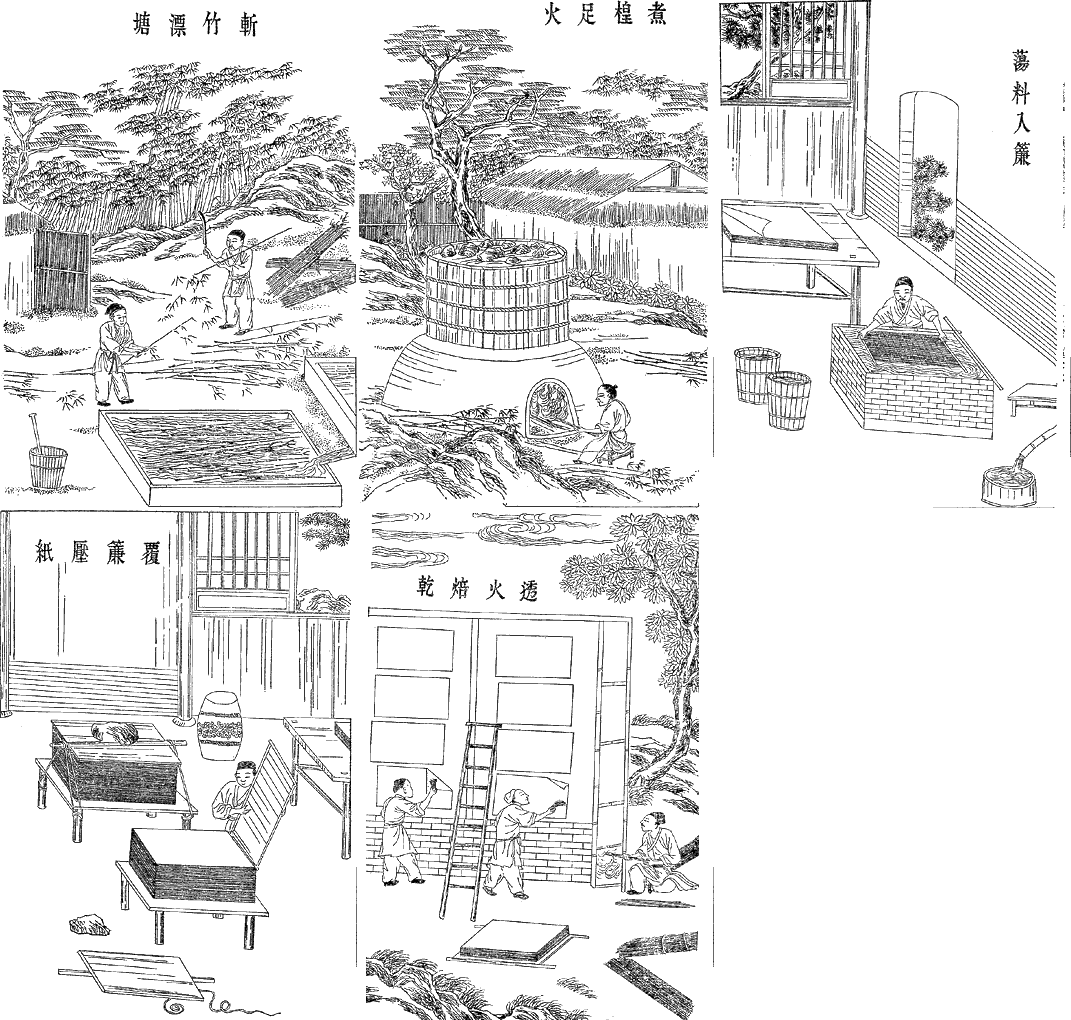
Although, before paper was invented, the Chinese had bamboo scrolls and Europe had parchment, but these were heavy and scarcely available. However, while different types of pulp paper existed in China since 2nd century BCE, they were mostly used for packaging, shoes and hats. It was during the 3rd Century Han dynasty, that Cai Lun, an official of the imperial court, made paper a popular medium for recording. He added critical new ingredients, and designed a paper making process that made denser durable sheets—Ideal for writing and drawing. Although his motivation was so that he wouldn’t have to carry armfuls of heavy bamboo scrolls whenever he needed to find or record information. What it led to was a major paradigm shift. Bamboo scrolls were not only heavy, but had to be handcraft piece by piece. With Cai Lun’s paper mill (in image above), written records became cheep and available. A known fact in the study of the history of technology states that ‘the invention of technology inevitably leads to new inventions in response’—Paper inevitably lead to the Printing Press. This technology makes it possible to send accurate messages across long distances, record complex processes, propaganda, convey secret admiration, and most importantly industrialized the spread of information.

Hello everyone, I am Nikki Meng Qi Zhang, in 3rd year Architecture. I was originally going to blog about origami, but as I researched, I realized that one cannot talk about origami (or anything really) without first talking about paper. This film of pulp gave birth to our era of mass information exchange. Imagine how Newton could have found the gravitational constant of the universe if he did not have notepaper! Are you not fascinated by this material as well?

Geomancy/Astrology +Asian Architecture___Post 1


Often linked with Chinese Architecture, Feng Shui (literally translated as "Wind Water") is an ancient Chinese system that uses magnetism to harness the laws of heaven and earth, to receive positive energy flow ("Qi"- pronounce like our professors last name) in a dwelling space.

Since the discovery of the Chinese compass; which points South instead of North, an instrument called the Luopan (as shown in the picture) is used still today to discover areas of health and prosperity in the home. The Luopan is made up of a magnetic compass with 24 markings separated at about 15 degrees which sits in the center of a circular plate made of either wood or metal. This circular plate is called the heaven plate and has 40 concentric rings that freely rotate on a square wooden base called the earth plate. This instrument is actually an earthly image of the cosmos and is used to assign proper positions in time and space.

The lost art of Feng Shui is making a reappearance in the highly superstitious Western cultures of the Americas and is practiced by many celebrities and commoners that wish to achieve celestial balance. One can use the Luopan to discover directions that will bring auspiciousness to the home and also reveal areas of the home that would bring bad Qi as well. These directions often change as the earth rotates around the stars which changes the orientation of the Luopan for that time.

In architecture many homes are placed facing South, if space permits because of the south facing compass. This allows for optimal sunlight in all seasons. Many also believe that placing dwellings near water is very beneficial since it is the element that bears life. Water is believed to carry positive qi in and take negative qi away. Placing gold in certain positions of the home is believed to bring prosperity and even the direction of your work desk and bed influence learning and health.

I do believe in the thought of celestial energy and balance and how Feng Shui is most in tune with the harnessing of this energy. It seems that these days unpracticed, self-learning, energy shamans (as shown in the picture) are trying to charge others sums of money to incorrectly tell them the traditions used in ancient China. Many believe that some of the teachings have been lost in translation yet others still do practice this ancient geomancy the correct way.

by Aaron Chow_3rdyr.

Gold Crown of Chen-Ma-Chong


The Ancient Earthquake Detector


Ming Fu

Many fascinating technologies were born in the ancient Chinese civilization. One of which is the ancient earthquake detector (dizhenyi).

The original inventor of this earthquake detector was a Han dynasty Imperial scientist and astronomer named Zhang Heng (AD 78-139). The original detector was lost but some of the description of its construction was preserved. This device is crafted entirely out of bronze and consists of an oval shaped pot or urn eight “Chi” or around six feet in diameter with eight dragons with a ball in its mouth mounted around the side, each of which is looking down at a toad with open mouth directly below. Within the urn, a pendulum hangs in the middle and is connected to the dragons’ mouths through lever systems. In the event of a seismic activity even undetectable by human feel, the pendulum would sway delicately and would trigger one or more dragons to release the bronze ball into the toads’ mouth. The detector was described to be engraved and decorated with complex images and patterns.

According to preserved texts and records, the detector was able to pick up earthquakes up to around 400 miles away. Since the original detector did not survive long enough for modern scientists to analyze it, the secret behind its effectiveness remains unknown. The most common explanation is that the detector’s material was tuned to the low resonant frequency that earthquakes produce, so that it only picks up a certain range of frequency and ignores the “noise” of everyday activities. One can also determine the epicenter of an earthquake by analyzing which of the eight balls have fallen. In order for the detector to actually detect earthquakes, the pendulum has to be several feet long. It was also believed that the ancient Chinese took seismic activities as a sign from the heavens, which probably explains the work and effort went into developing such a device.

Not only is the ancient earthquake detector a functional piece of machine that showcases the sensitivity and delicacy of ancient Chinese technology, it is also a example of the understanding of physics at such an early time.